
I am going to show how to learn electronics for beginners. Imagine that you are interested in learning new things that are not familiar and everything seems confusing.
I used to be like that. Therefore, I do not want you to be like me. We should start from a simple. Until you have developed without knowing it.
Let me explain it to you, in step-by-step learning.
Why learn electronics?
I have three answers to the above questions that will help you see it more clearly.
1# What is Electronics?
Electronics are something around us. For example, cell phones, computers, televisions, etc.
Every appliance needs electricity as energy by plugging in a house or charging with the AC adapter.
Inside these appliances consist of devices called electronic components.
They are connected in a manner known as the electronic circuit.
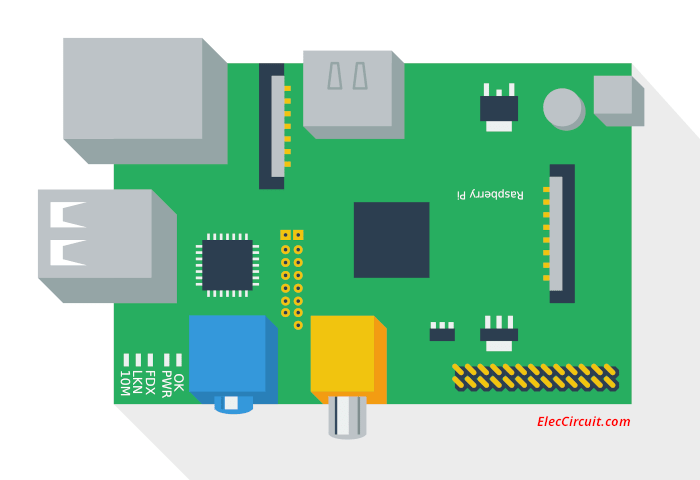
By using these appliances, we do not need to learn the workings of the electronic circuit inside them. But…
2. Why learn Electronics?
There are a lot of reasons to should learn electronics. But the 4 main benefits are:
Be able to build electronic circuits
If you have a passion for electronics. You should learn electronics by using electronic circuits to create fun projects. To solve everyday problems and make your free time enjoyable.
Save time & money
Also, if you have technical skills. You can save money. Because when the appliance is broken. You can try to repair it first.
Great future awaits
Learning electronic circuits is a very good skill or ability. Imagine you can build electronic circuits. Understand its working principle, until becoming an expert. When there is a job opportunity, you could be selected to work.
Great for studying
Moreover, it is great for studying too. Because electronics is a branch of science. Which has a clear reason, therefore it can be understood in a systematic way. But learning the principle of its operation alone is a tedious thing. Therefore, it is better to learn by building electronic circuits.
3. Who should learn electronics?
Change the old way of thinking. Electronics are not as difficult as you think, you could easily learn them.
- A student or anyone who is interested in electronics as a hobby.
- Parents who looking for a good activity for their children.
- Even a homeschooling parent wants to teach their children to learn electronics as well as me.
It is very difficult to make electronics easy for kids. Therefore, parents should learn together with their kids.
It is not too late for you!
Some of my friends are about sixty years old. Play with their grandchildren about electronics. It is a fun activity.
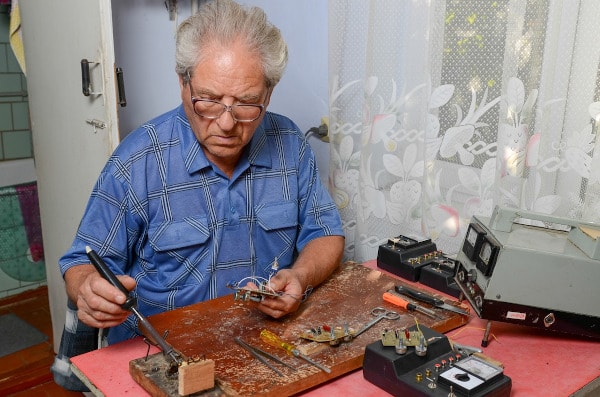
Electronics are the ultimate activity for retirees.
We can create projects with concentration, interact, and really experiment with devices. Sometimes we do simple math calculations to solve problems. Therefore, our brains have developed nonstop.
Also, we moved the body when creating a large project (sometimes).
Or even that failed project, we also learned something. Maybe it will also benefit other people not to make the same mistake as ours, by sharing experiences.
What is the best way to learn?
You have seen a lot of content. Then, how would you start? What method is best? Are electronics easy to learn? Imagine you are sitting in the classroom studying scientific theory. Many people may be bored. And can not remember all the theories. It may be difficult to study electronics for beginners
Let’s learn through problems
I believe that problems are the cause of learning in everything around us. In the past, we were in the dark. Therefore, we create a light bulb. The building process is great learning. And, an important tool is time and regularity in the experiment.
What about you? Let the problem go through or fix it. In my opinion, we do not need to know the theory of all electronics. But, we should always develop our way of thinking. So that we can solve the future problem in the best way possible.
We love this “Experience is the only source of knowledge” – Albert Einstein , and you?
How to learn electronics for Beginners
Now you probably have the dream. For example, you want to build a circuit, modify the circuit, and make practical use of various circuits. But it has many components and details. It may cause some confusion.
The best way to learn electronics for beginners!
My mom used to teach me that we always have various ways to reach a goal. Every learning has an important condition: Time and consistency.
Or, if the target is far away, walk slowly and steadily.
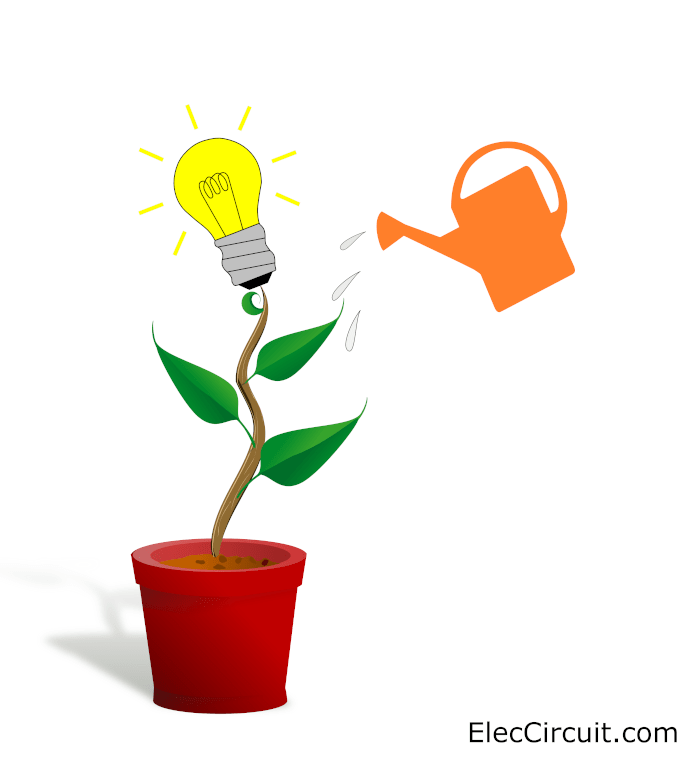
Learning about Electronics is like planting trees, it takes time and little watering regularly.
How long does it take to learn electronics? We cannot receive a lot of information about electronics at the same time. Therefore, take a little time to learn it regularly, and let’s find out what kind of tree are we.
Let’s get started with these 3 steps.
Basic Electronics
What are the basics of electronics? Read below you will get answered.
Electronic components
Because we need to use them to build Electronics circuits. If without learning the name and how they work. Else, We would not be able to use them. Therefore, we should read the Electronic components list with images.
They are pictogram that shows instead of electronic components or a simplified version of real electronic components. Used in circuit design, creation, repair, modification, learning,
Voltage, Current, Resistance & Ohm’s Law
Learn the relationship between voltage, current, resistance, and power by comparing the flow of water easily. Look at Ohm’s Law, basic electricity you should know. Read more about Voltage, Current, and Resistance Relationship
And others
Common Electronic Components
There are many electronic components. But what should we learn? Frequently used And important. I compiled the content in these parts, below as follows.
Resistors
Let me tell you about the resistor color code and how it works. We often look at a lot of resistors in many electronic circuits. Do you know how to use it…
Capacitors
We always use capacitors in electronic circuits. But Do you understand them enough? Review now: Capacitor working principle. You may improve its operation.
LED
The First time learning how to use LEDs. It is an excellent teacher to learn a current limit. Read more: LED circuit diagram
Zener Diode
We often use a Zener diode in a lot of electronic circuits. But…Do you understand well enough? What is the Zener diode?
SCR
Have ever seen SCR? Some may use it instead of switches and relays. Because we have seen it works high speed and quiet. Learn How SCR works
Transistors
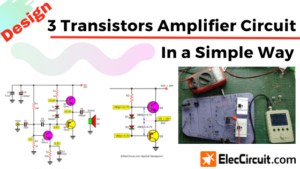
Learn transistor works, old parts But, we often use it. Because of durable, high current. Whether any reason. Let’s learn they work in a simple way.
Recommended:
- Experiment with transistor as switch
- Experiment with Parallel Transistors for More Current
- Experiment with adjustable transistor circuits partially on-off
IC — Integrated Circuits
It makes your circuits smaller, more efficient, and cheaper. Let’s choose the most popular ICs, so they are easy to find and cheap too.
NE555
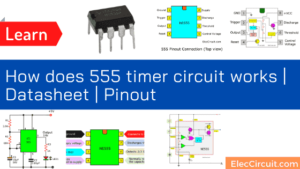
Learn how does NE555 timer work. Datasheet, Pinout, Circuit diagram inside. See basic stable multivibrator (Free-running) or square wave oscillator circuit.
CD4017
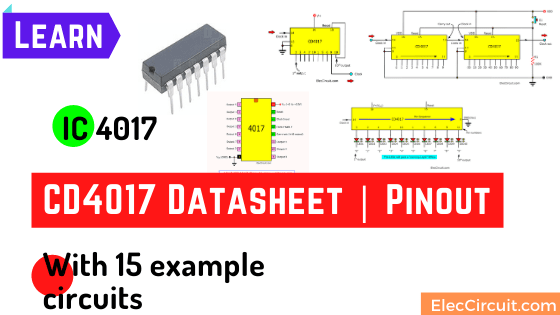
When we build LED chaser circuits for a hobby, we often use a CD4017 CMOS IC. Why would we choose this exact IC? The CD4017 is one of the most versatile number counters. It can count up to 10 and has 10 separate outputs. […]
Let’s learn more about CD4017 Datasheet & working explained by experimenting with many circuits.
Building the circuits
Electronics is a mechanic. Although you understand the principles of electronic work very well. But also need to practice technician techniques. This section makes your work to be complete smoothly. Of course, it takes practice, repeated many times, to become skilled.
Soldering on circuit board
Why project does not work? Sometimes the solder joint is bad. You need to know tips on How to solder a circuit board. Easy but have to practice!
If you are looking for some electronic components for your projects. I would like to recommend to you some electronic supplies store.
We probably used to use lead-acid batteries. But do you understand how to basic charge it yet?
Of course, we need to adequately understand the principles of electronics. So you can create the project exactly as you want. See below. Here’s what you should know.
Learn Many Electronics circuits
Most people want to build big projects like high-wattage amplifiers, Microcontrollers, etc. Do you know those include many small circuits inside? So, We should start learning with small, primary, or even tiny circuits. If we understand them, we will design electronic projects ourselves. But we cannot learn all of them in a short period of time. It will be better if we learn little by little and regularly.
Basic Circuits
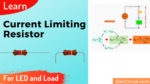
How to reduce voltage for LED and other loads. We use a limiting current resistor to reduce current or voltage in a series circuit. So easy to do.
How a simple series circuit works
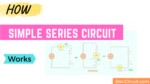
Let’s understand the current flow and voltage across devices and calculate it with an easy formula.
Why do we use often them in circuits? Let me explain to you understand them to work, rule, calculate easily.
Learn basic uses of capacitors, Capacitance, capacitive reactance Xc. Connecting them in parallel and series. We can use RC time constant and coupling circuits. […]
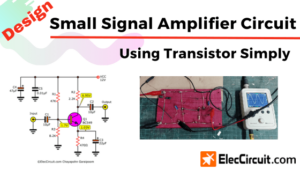
Learn: Designing small signal amplifier circuit using transistor simply
Power Supply Circuits
Principle of unregulated power supply
Almost all circuits are based on this principle. Of course, ask your mind. Should you read it?
Fixed voltage Regulator Working principle
Even though I don’t like complexity. But every project needs good stability. So, this is necessary. We should use it and understand it!
Constant current circuit using transistors — Sometimes you may need it. To control the stable current to the load when the voltage changes.
Overload and short-circuit protection
Let’s learn about the transistor series voltage regulator with short circuits and overload protection. And how it reduces ripple.
741 Op-Amp Power supply Circuit works
Look! How an error voltage sensor works. Using transistors circuit. See example circuits of Variable voltage regulators using 741 and 2N3055.
DC to DC converter circuit works
Is the switching supply circuit hard, especially for a beginner or an electronics hobbyist? Yes! But wait, try to read this. It may change your mind. We can try to play with inexpensive parts or incomplex.
Switching Power supply vs Linear, How Does It Work?
Why do people pick a switching regulator? It has the high-efficiency in its small. Nowadays, most devices use them.
What is switching Power supply?
Understand Digital working
Learning electronics for beginners, we should also understand digital circuits. Because we are in the digital age. Here are the basics of the microprocessor system. Beginning education with a simple way of thinking should be able to real used and good value, too.
- CMOS Circuit —- Know the characteristics of CMOS IC and how to use
- How Astable Multivibrator using Logic Gates work | Example Circuits
GET UPDATE VIA EMAIL
I always try to make Electronics Learning Easy.
Related Posts
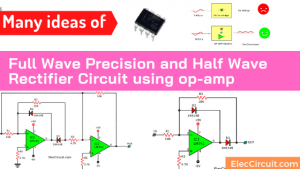

I love electronics. I have been learning about them through creating simple electronic circuits or small projects. And now I am also having my children do the same. Nevertheless, I hope you found the experiences we shared on this site useful and fulfilling.
Thanks.
smart son.. 🙂
What the cost?
Regards Roger.
Very educative for a young person who wants to study Electronics.
Hello Sylvester,
Thanks for your feedback. Your text make me strong. I will keep it up.
From Greece with love , thank you for all intresting informations.
stay safe.
Hello georgios vasileiou,
Thanks for your feedback.
3
Hi,
Do you have anything I can help you with? 🙂
Thank You
Lenguaje sencillo simple explicaciones de los temas especial para los iniciados
Thank you for your feedback.
I am a beginner can anyone teach or explain it easier?
Hi john,
I’m a beginner as well. My father teaches me every day. I gradually learned it. https://www.eleccircuit.com/quick-learn-basic-electronic-components. We will gradually add more content, hope to follow. 🙂