
Let’s make a voltage doubler with the TDA2822 – simple charge pump circuit. This circuit is a charge pump voltage doubler driven by an audio amplifier IC (TDA2822), allowing you to boost 6V to 12V without using inductors.

What should we do if we want to power a high-voltage load from a low-voltage battery? The simple solution is to increase the battery voltage. There are various ways to do so, including this charge pump circuit that uses the TDA2822 to double the voltage. It can raise the input voltage from 3V-12V to 4.5V-22V with a maximum current of 300mA.
Some may wonder why we would use the TDA2822 for this, given that it is a dual low-voltage power amplifier chip commonly used in small stereo audio amplifiers. But, in this pump charge circuit, we are using the TDA2822 as an oscillator to charge capacitors.
Without further ado, let’s start with the complete circuit. Then, we will learn about the idea behind this circuit and the basics of the pump charge system.
Charge Pump Voltage Doubler Circuit using TDA2822
The circuit schematic above may seem complicated, but the circuit itself can be divided into parts with specific jobs. Apart from the TDA2822 IC, this circuit is comprised of arrays of diodes, capacitors, and resistors, but no inductor or coil.

Unlike the buck-boost converter circuits, this circuit does not have any inductors. Instead, it increases voltage with the timed charge and discharge of two capacitors. Not having to use an inductor is one benefit of this circuit.
Recommended: What is switching power supply vs linear, how does it work?
How It Works
Let’s look at this simple block diagram to understand the basics of how the circuit works. The block diagrams below are very much simplified, but at the very least, they will help us understand each part of the circuit.
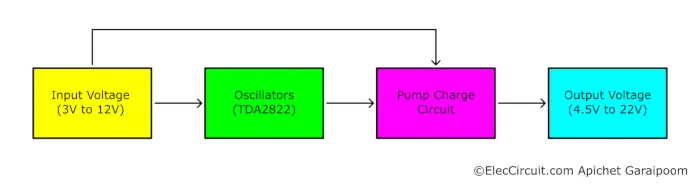
Let’s get over it block-by-block, starting with:
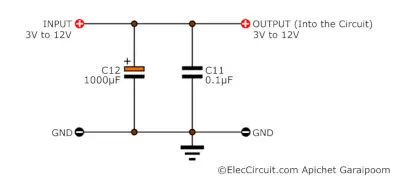
The input voltage — This circuit accepts 3V to 12V input voltage, as roughly determined by the IC (TDA2822 supply voltage ranges from 1.8V to 15V). At the input of the circuit, there are also two filter capacitors, C11 and C12, which help smooth the current into the circuit.
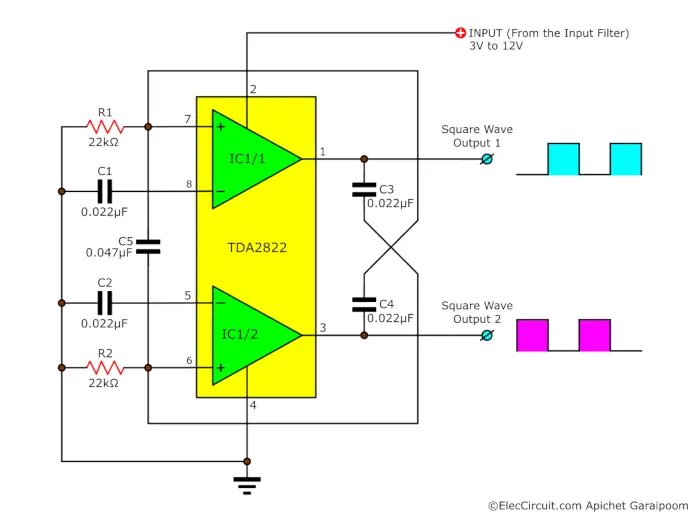
Oscillators — This part of the circuit consists of the TDA2822, R1, R2, C1, C2, C3, C4, and C5. The TDA2822 has two OP-AMPs inside of it, and they function as an astable multivibrator. The output of each OP-AMP, pins 1 and 3, should have a different phase square wave signal.
Pump charge circuit — It consists of C8, C9, D1, D2, D3, and D4. Capacitors C8 and C9 take turns charging and discharging according to the oscillator outputs.
During the “low” phase of the square wave, currents from the input flow through D1 or D3 to charge C8 or C9. However, during the “high” phase, the capacitors discharge both the input and the square wave through D2 or D4 to the output.
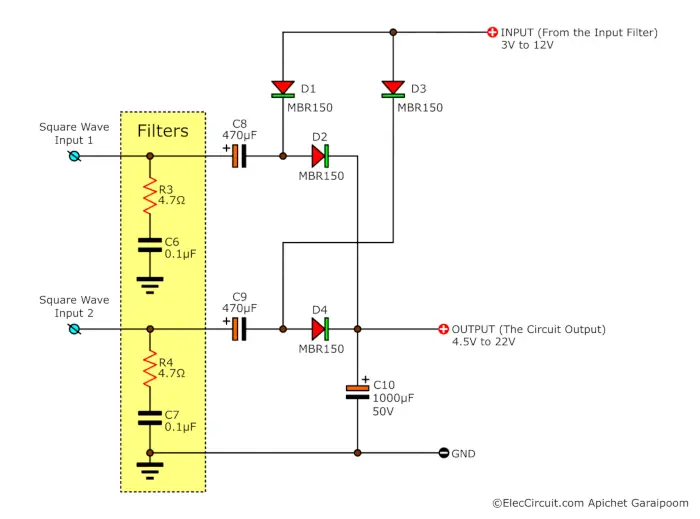
The output voltage — It is the voltage across the C10 output filter capacitor. The voltage of C10 is a combination of the input voltage and the voltage from the “high” phase of the square waves. From 4.5V to 22V, the output voltage across C10 is roughly double that of the input.
This is but a simplified diagram of the circuit. In practice, we only need to know that this circuit utilizes the pump charge circuit to double the voltage. But how does the pump charge circuit work? Let’s take a quick look at the basic theory of the pump charge circuit.
Principle Behind This Circuit
For this part, let’s assume that we use a 5V input voltage (DC = 5V, square wave “high” = 5V). In theory, the two square waves from the astable multivibrator should be at the same frequency but 180 degrees out of phase with one another. In other words, when one is “high,” the other is “low,” and vice versa. We can see that the oscillator outputs are represented by blue and pink square waves in the simplified cut-out schematic below. On the other hand, the input DC that continuously flows into this circuit is represented by the green graph.
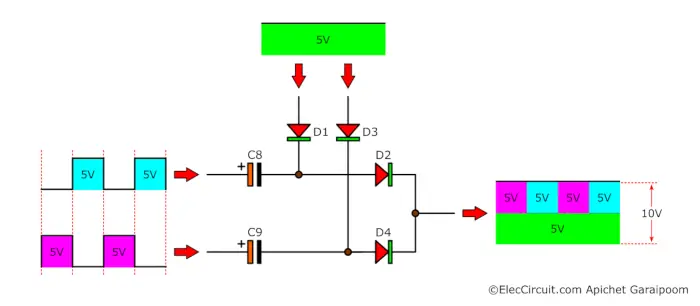
In the “low” phase of the square wave, the DC voltage (green) charges the capacitor. And in the “high” phase, the DC voltage (green) gets discharged alongside the square wave.
The current discharge from the capacitor should be twice as much as from the input DC (DC + square wave “high”). Furthermore, because the two capacitors (C8 and C9) are working alternatively, there is a constant current flow to the output.
In the full circuit above, this discharge current flows through D2 and D4 to charge C10, which acts as a buffer, smoothing the current for the load.
However, that is just the theory. In reality, we take some measurements of this circuit, and it is not entirely perfect. Some notable mishaps are as follows.
- Using a simple oscilloscope, we measure the output frequencies and waveforms of the two OP-AMPs (pins 1 and 3 on the TDA2822). At pin 1, it reads a 2.8kHz square wave. At pin 3, it reads a 3.6kHz square wave.
- The output voltage is not entirely double that of the input. When we supply the circuit with 5V, the output voltage is 9.1V.
But with that said, this circuit still works. The mismatch frequencies are not as big a problem since there is always a chance that one is “low” and the other is “high”; it is just not as effective as it could be.
Furthermore, a roughly 10% loss in voltage at the output is acceptable for most basic usages, and this circuit could still output up to 300mA of current.
Building the Circuit
We bought this circuit as a complete build kit, a very long time ago. However, if you would like to build this circuit as well, you can definitely use the component list below and assemble it onto a universal PCB.
Component List
Resistors 0.25W 5%
- R1, R2: 22K
- R3, R4: 4.7 ohms
Ceramic Capacitors, Mylar Capacitors
- C1, C2,C3, C4: 0.022µF 50V
- C5: 0.047µF 50V
- C6, C7, C11: 0.1µF 50V
Electrolytic Capacitors
- C8, C9: 470µF 25V
- C10: 1,000µF 50V
- C12: 1,000µF 25V
Semiconductors
- IC1: TDA2822 Dual Low Voltage Amplifier IC or equivalent
- D1, D2, D3, D4: MBR150 Schottky Diode
Others
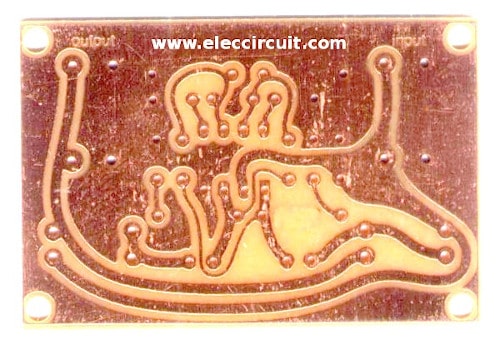
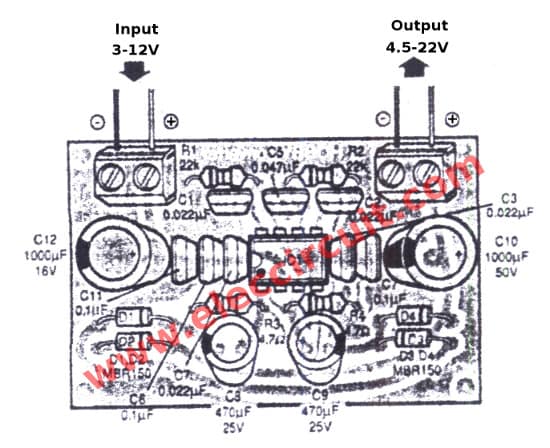
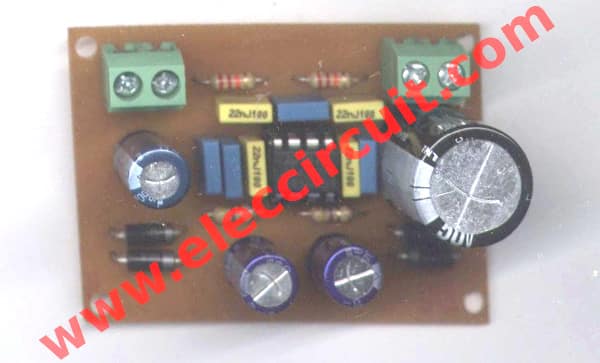
Below are some pictures of our kit board. If you want a PCB design for this circuit, then be sure to let us know; we will design one.
Read next: USB 5V to 12V DC-DC Step-Up Converter circuit
The components layout
Circuit Testing
Next, let’s test this voltage doubler circuit to see if it can boost the voltage high enough. We’re using a 6V battery as the power source and a 12V LED bulb as the load. Normally, the LED wouldn’t light up at all because the voltage is too low. But when we add this circuit, it makes the LED light up immediately. We also measured the output voltage with a multimeter, and it showed a peak of 10.7V, which is enough to make the 12V 3W LED light up as needed.

Conclusion
In conclusion, this charge pump doubler circuit works as it should, in that it can convert voltage from 3V-12V to 4.5V-22V at a relatively high current. Furthermore, this circuit operates without inductors or coils, which may be useful when those components are unavailable.
With that said, most buck-boost circuits that use inductors will also have higher efficiency. Even compared to other pump charge circuits, this one is not that impressive. Still, this circuit can teach us how this type of doubler circuit works.
If you are interested in other alternative circuits, here are a few we can think of:
- 3V to 12V DC Boost Converter Circuit
- 5V to 12V Converter Circuit – Easy Transistor-only Boost Converter
- 12V to 24V Boost Converter — Efficient DIY Circuit with 5A Output
Extended content available on Patreon
The full version includes deeper technical discussion, experimental insights, and clean PDF downloads with high-resolution diagrams — all ad-free.
👉 Read more on Patreon
Hello. I’m Chayapol, but I could also go by Aot. I write and draw illustrations for ElecCircuit.com.
I usually cover articles related to digital electronics, logic, or basic principles or ideas on the site.