Contact: webmaster@eleccircuit.com
eeweb.com
Advertisement

Posts Tagged ‘high voltage’

High-Voltage Regulator With Short Circuit Protection

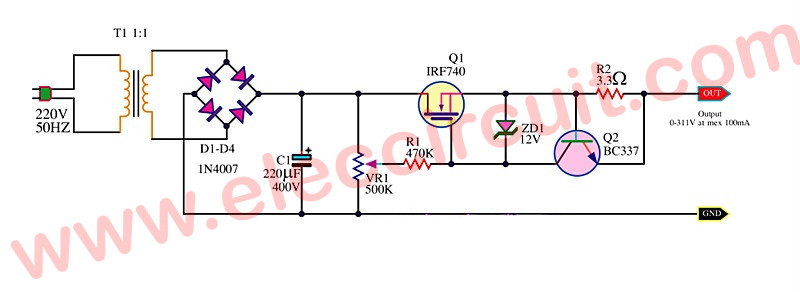
There are many circuits for low voltage regulators. For higher voltages, such as supplies for valve circuits, the situation is different. That’s why we decided to design this simple regulator that can cope with these voltages. This circuit is obviously well suited for use in combination with the quad power supply for the hybrid amp, published elsewhere in this issue. The actual regulator consists of just three transistors. A fourth has been added for the current limiting function.

The circuit is a positive series regulator, using a pnp transistor (T2) to keep the voltage drop as low as possible. The operation of the circuit is very straightforward. When the output voltage drops, T4 pulls the emitter of T3 lower. This drives T2 harder, which causes the output voltage to rise again. R4 restricts the base current of T2. C1 and C2 have been added to improve the stability of the circuit.

These are connected in series so that the voltage across each capacitor at switch-on or during a short circuit doesn’t become too large. You should use capacitors rated for at least 100 V for C1-C3. D1 protects T2 against negative voltages that may occur when the input is short-circuited or when large capacitors are connected to the output. We use two zener diodes of 39 V connected in series for the reference voltage, giving 78 V to the base of T3.

Because R6 is equal to R7 the output voltage will be twice as large, which is about 155 V. T4 acts as a buffer for potential divider R6/R7, which means we can use higher values for these resistors and that the voltage is not affected by the base current of T2 (this current is about the same as the emitter current of T3). This is obviously not a temperature compensated circuit, but for this purpose it is good enough.
[...]
Source:
Author: Ton Giesberts – Copyright: Elektor Electronics
http://www.extremecircuits.net/2010/06/high-voltage-regulator-with-short.html

Be the first to comment - What do you think?  Posted by admin - June 28, 2010 at 5:47 am

Categories: High voltage   Tags: ,

High volt shock by transistor 2SC458

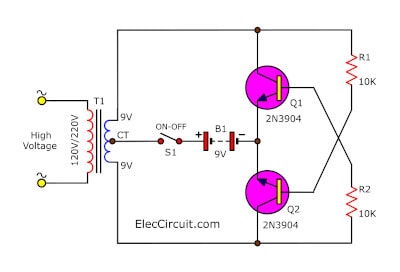
This the high voltage circuit pressure from the low beam in the character High volt shock. When switch S1 close the circuit for feed power supply give with Q1 and Q2. By current flow through coil of transformer of the primary and touch limit current with R1 and R2 already change come in pin way B of Q1 and Q2. It make Q1 and Q2 bias by transistor that bilateral alternate work all the time. When Q1 bias make have current flow change during a half on of coil primary and when Q2 make have current flow during a half below of coil primary. Which work alternation of Q1 and Q2 can make be the electric current alternates to come out at coil secondary cell building this circuit should use the carefulness. because of might born dangerous from the electric alternating current.

Be the first to comment - What do you think?  Posted by admin - June 21, 2010 at 9:56 am

Categories: High voltage   Tags: , ,

CEMF Charger high voltage out

The CEMF charger uses the CEMF (counterelectromotive force) from an inductor to charge a capacitor to high voltages from a low voltage source. A simple schematic of a CEMF charger is shown below.

Source: http://www.geocities.com/mistertippy/schematics/CEMFC.html

Be the first to comment - What do you think?  Posted by admin - July 6, 2008 at 12:05 pm

Categories: High voltage, Power supply   Tags:

Advertisement

Next Page »