MCU Control Motor Speed and Direction
This the DC motor controls circuit with a signal MCU. By can control DC Motor 24V can fine the speed of motor with pulse and timer (MCU). This circuit composes transistor and power mosfet (MBR1045). Then motor driver has been verying and still have the circuit changes the direction of motor Reverse Rotation get Relay 24V 20A get back to electricity pole has with. The detail is other , see in the circuit.
Source: aircraftdesigner
Categories: Electronic Control Tags: 24V motor control, dc motor drive, power mosfet control
Toy Motor Driver Circuits
This is an actual reverse engineered circuit diagram of the one transistor circuit most commonly used to drive Permanent Magnet DC motors in childrens’ toys. This type of circuit almost always uses the 625mW version of the ubiquitous 8050 or 8550 transistor. It is vital to note that there are two different varieties of each of these two transistors, and although they are often stamped with the same part number, they are not interchangeable because one is a 625mW part with a higher VCEsat, while the other is a 1W part with a lower VCEsat. This is very confusing because you often have to run tests on these transistors to tell them apart! The important feature to note about this circuit, is that the maximum power delivered to the motor is normally designed to be limited by the VCEsat of the transistor, and almost never by the HFE or base current. [...]
Read more source:
http://www.members.shaw.ca/novotill/ToyMotorDrivers/index.htm
Categories: Motor controller Tags: dc motor drive, small dc motor control
DC Motor-Driver H-Bridge
Physical motion of some form helps differentiate a robot from a computer. It would be nice if a motor could be attached directly to a chip that controlled the movement. But, most chips can’t pass enough current or voltage to spin a motor. Also, motors tend to be electrically noisy (spikes) and can slam power back into the control lines when the motor direction or speed is changed.
Specialized circuits (motor drivers) have been developed to supply motors with power and to isolate the other ICs from electrical problems. These circuits can be designed such that they can be completely separate boards, reusable from project to project.
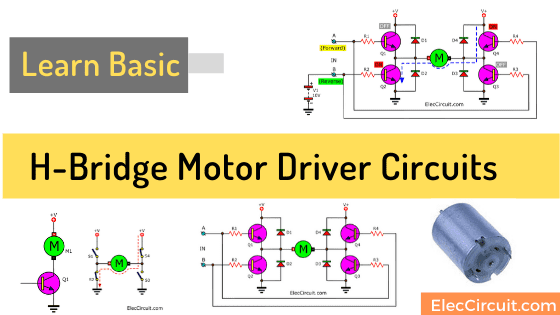
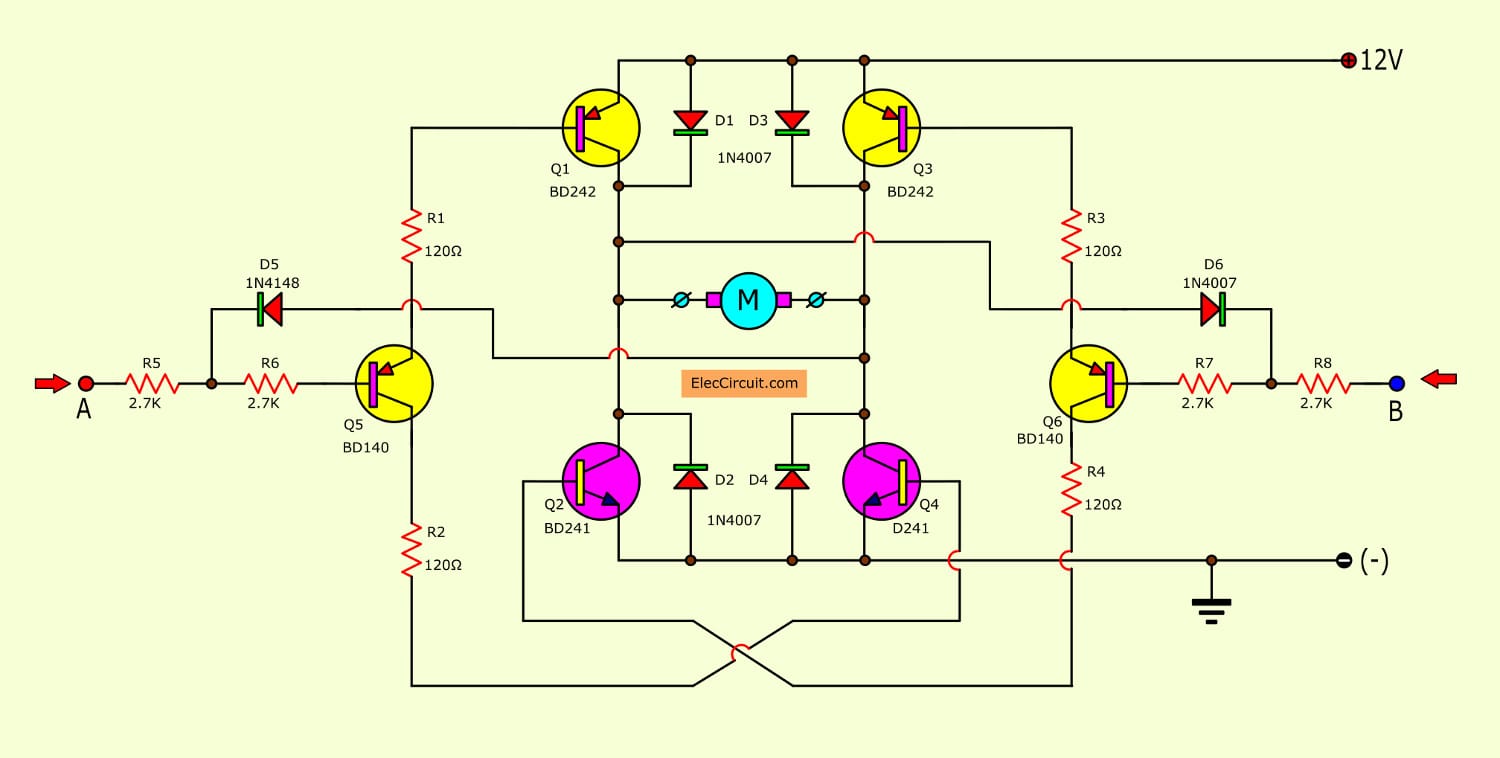
A very popular circuit for driving DC motors (ordinary or gearhead) is called an H-bridge. It’s called that because it looks like the capital letter ‘H’ on classic schematics. The great ability of an H-bridge circuit is that the motor can be driven forward or backward at any speed, optionally using a completely independent power source.
An H-bridge design can be really simple for prototyping or really extravagant for added protection and isolation. An H-bridge can be implemented with various kinds of components (common bipolar transistors, FET transistors, MOSFET transistors, power MOSFETs, or even chips). [...]
Source: By David Cook
http://www.robotroom.com
Related Links
More Circuit about dc motor drive
More Circuit about H-bridge
PWM Control Speed Motor 12V By TL494
PWM Speed Motor Controller By IC 555
Stepper Motor Driver using L298 and L297
Stepper Motor Controller by ULN2003
DC Motor Driver with L6203
Full-featured Dual H-bridge
Categories: Motor controller Tags: dc motor drive, H-bridge


or